Module 1 — Lash Science Fundamentals
The safety & knowledge foundation of a professional lash artist.
1. Natural Lash Anatomy
Understanding lash anatomy is critical. You are working very close to the eye; improper knowledge can cause injury.
Key Structures You Must Know
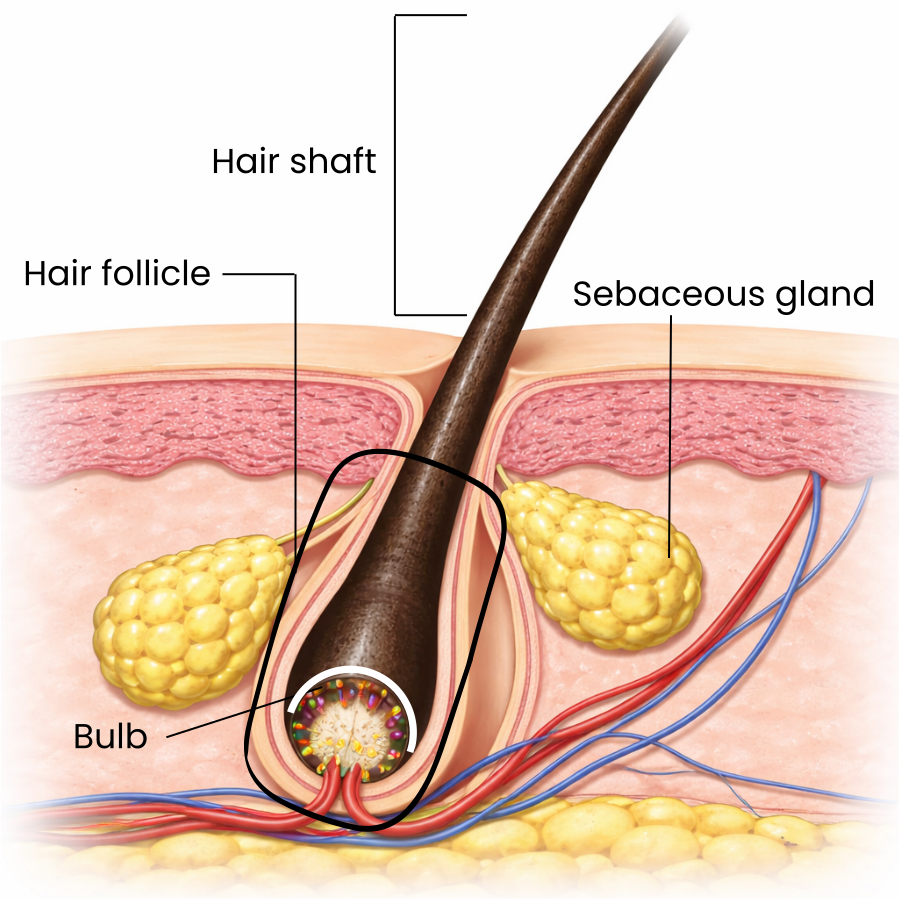
- Hair Shaft — The visible part of the lash, made of keratin. This is where the extension is attached.
- Hair Follicle — The root beneath the skin. Supplies nutrients to the lash. Damage here can cause permanent loss.
- Bulb — Base of the follicle where active cell growth occurs.
- Sebaceous Glands — Produce natural oils. Excess oil affects adhesive retention.
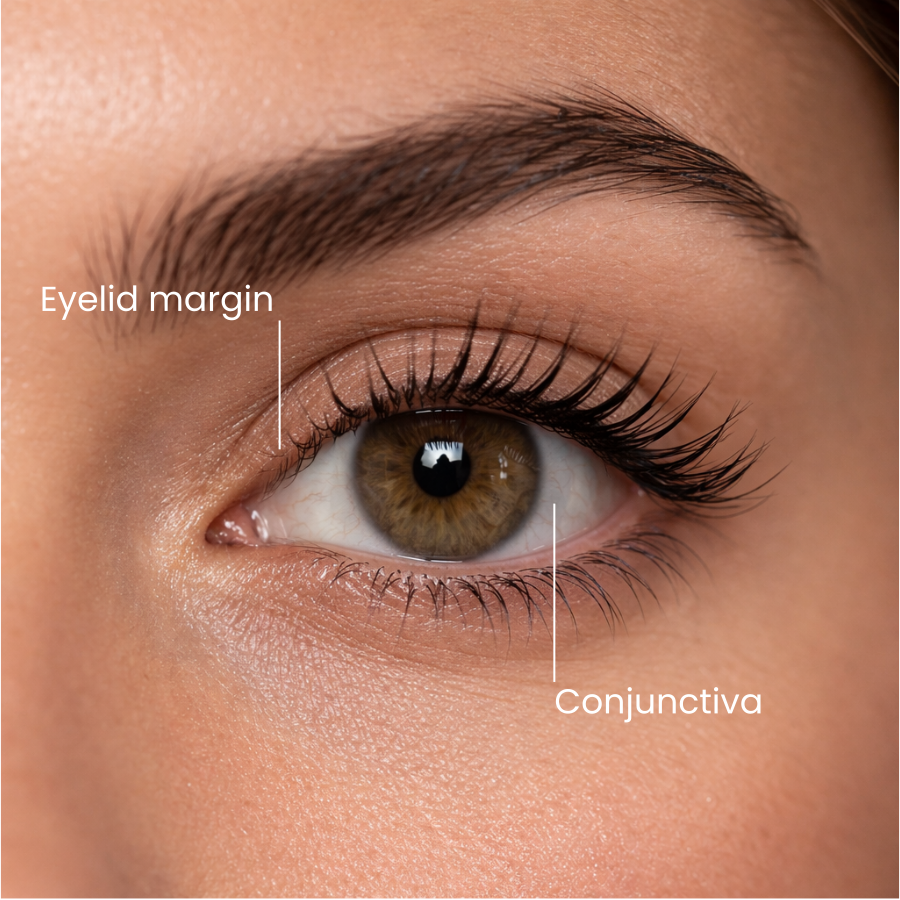
- Eyelid Margin — The skin edge where lashes grow. Extensions should never touch the skin.
- Conjunctiva — The clear membrane covering the white of the eye (sclera). Chemical exposure here can cause burning or injury.
2. Lash Growth Cycle
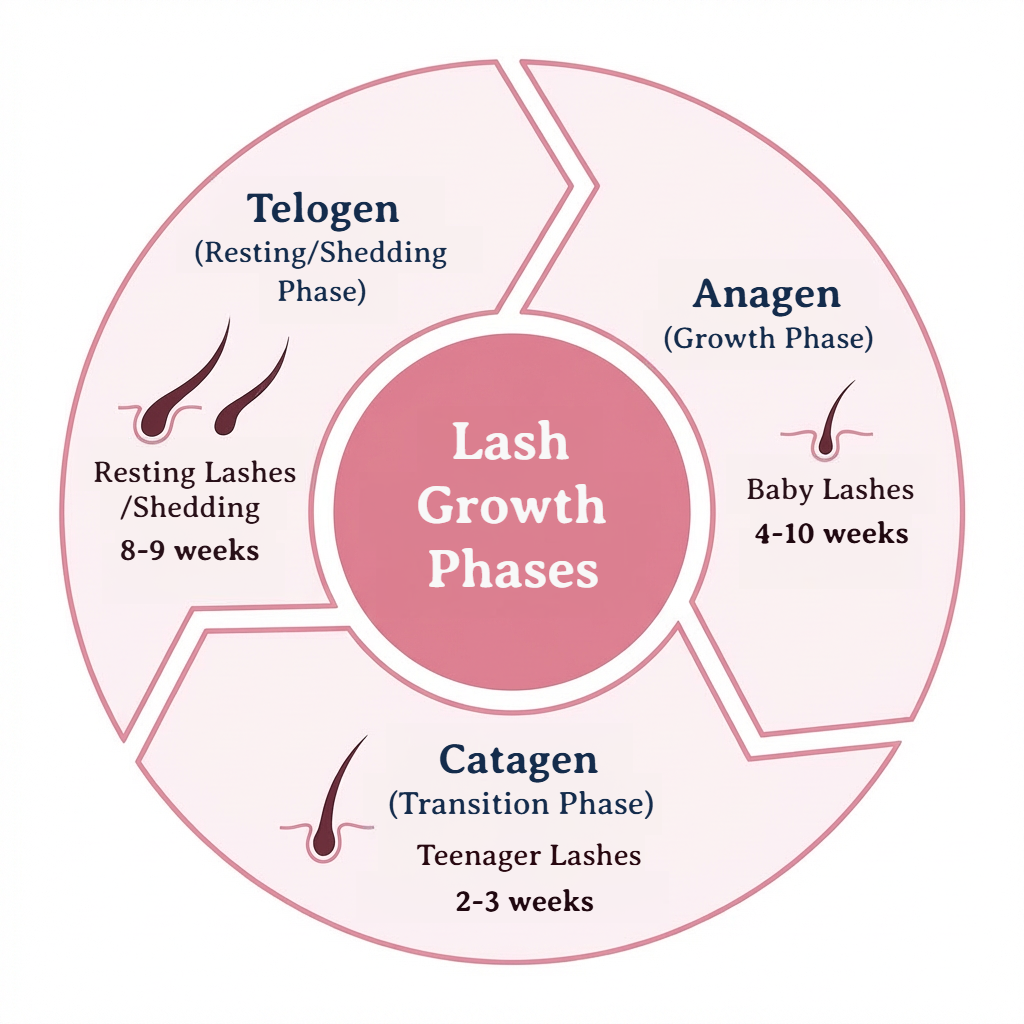
Every natural lash is at a different stage of growth. This is why clients naturally shed about 1–5 lashes daily.
The 3 Phases
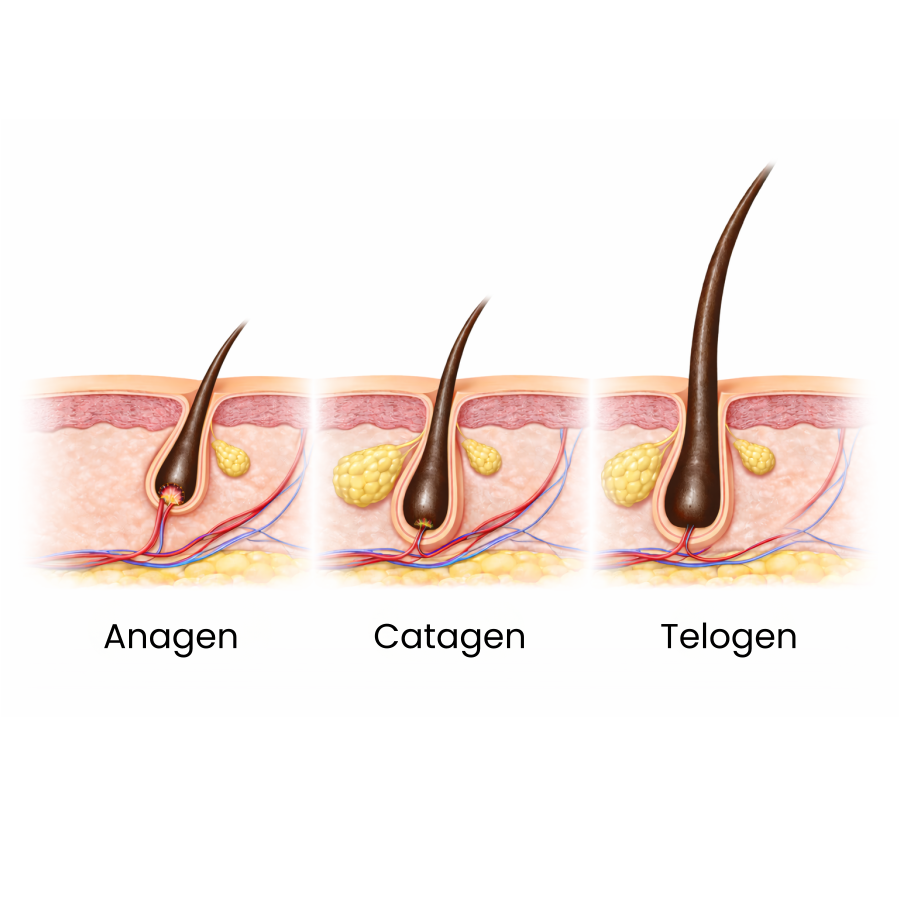
- Anagen (Growth Phase) — “Baby lashes.” Short, thin, fragile, still growing. Lasts 30–45 days. Classic rule: Avoid applying extensions on thin baby lashes. Avoid attaching heavy or long extensions to strong, thick baby lashes.
- Catagen (Transition Phase) — Lash stops growing, “Teenager lashes.” Follicle shrinks. Stronger than anagen. Lasts 2–3 weeks. Extensions can be applied, following weight rules from future modules.
- Telogen (Resting/Shedding Phase) — Fully mature lash, “Adult lashes.” Strongest phase for attachment. Eventually sheds naturally. Lasts 1–4 weeks. Extensions can be applied, following weight rules.
Why Growth Cycle Knowledge Matters:
- If you overload anagen lashes → premature shedding.
- Weak lashes → traction alopecia.
- On multiple lashes → clumping and damage.
- Retention isn’t just about adhesives; it’s about biology.
Bonus: Increased Lash Shedding (Normal vs. Concerning)
When Increased Shedding Is Normal:
- Seasonal shedding (Spring & Fall)
- Pregnancy & postpartum (2–4 months after birth)
- Hormonal fluctuations (menstrual cycle, thyroid, birth control, PCOS, stress, rapid weight changes)
Educate clients during consultation, document on intake forms, avoid overloading fragile lashes, adjust fill schedule, maintain realistic retention expectations.
When Shedding Is NOT Normal — Refer out if:
- Patchy or bald spots
- Accompanied by redness or inflammation
- Painful
- Sudden and severe
These may indicate alopecia, blepharitis, infection, or medical conditions. When in doubt → refer to a physician.
3. Lash Growth Direction & Natural Lash Patterns
Natural lashes grow in different directions, angles, and layers, with natural asymmetry.
- Inner corner (medial):
- Often grows downward or sideways; finer and shorter.
- Use shorter, lighter extensions and softer curls.
- Mid range:
- Usually grows more upward; strongest and thickest.
- Best support area for length.
- Often carries the longest lengths in a classic map.
- Outer corner:
- Often grows outward or downward; can be weaker.
- Avoid overly long or heavy lashes here.
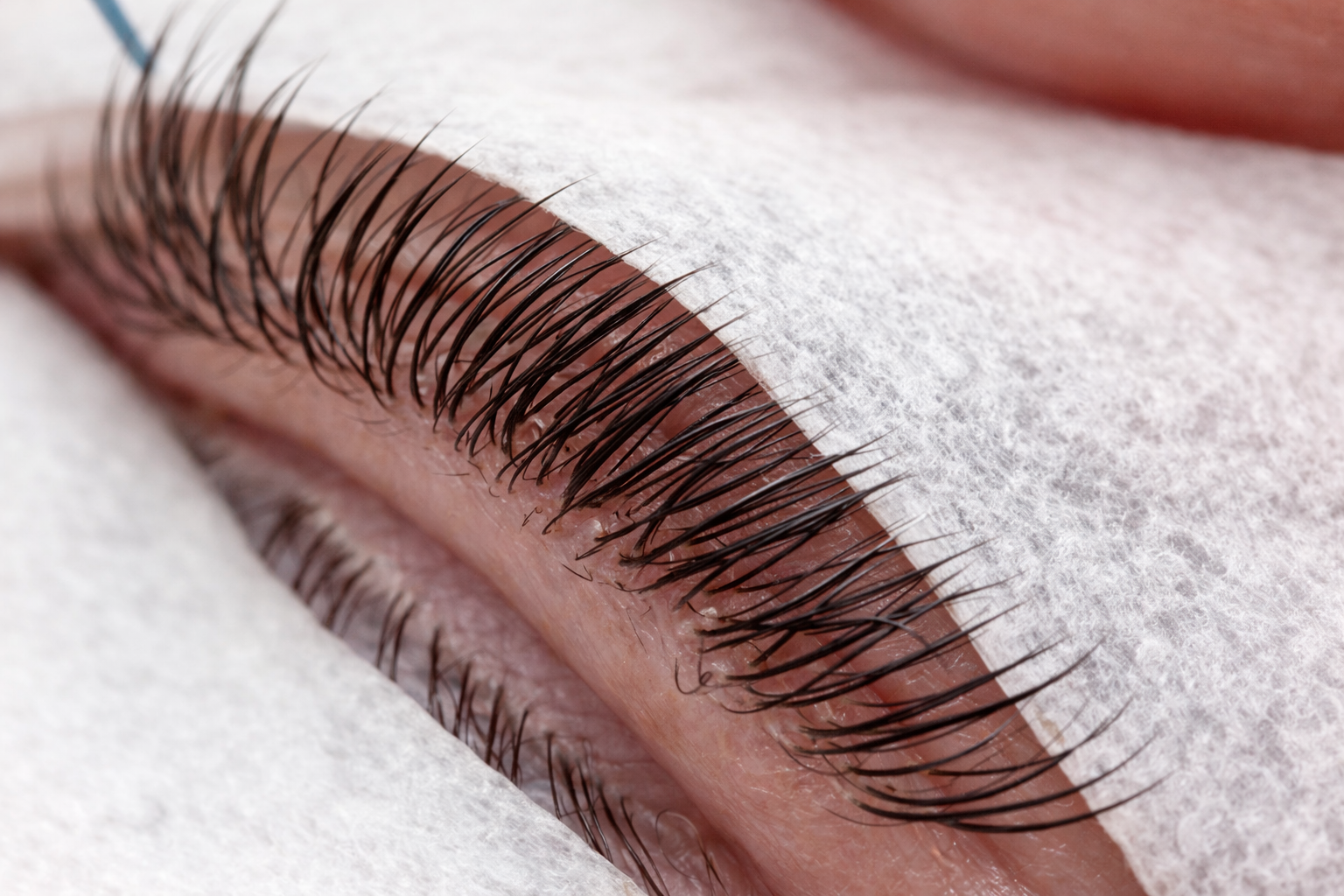
Lash layers: Natural lashes grow in 3–4 layers (top longer, middle, sometimes another middle, bottom shorter baby lashes). Ignoring layering creates jagged lash line and decreases retention. Proper layering creates smooth top line, dense appearance, professional finish.
4. Contraindications
A contraindication is a condition that makes lash extensions unsafe. You must assess every client before service.
Absolute Contraindications (DO NOT LASH)
- Active eye infection (pink eye / conjunctivitis)
- Styes
- Blepharitis (severe untreated)
- Recent eye surgery (under 6–8 weeks)
- Severe allergic reaction history to adhesives
- Chemotherapy-induced fragile lashes
If unsure → refer to a medical professional.
Relative Contraindications (Proceed With Caution)
- Mild seasonal allergies
- Contact lens wearers
- Sensitive eyes
- Pregnant clients (strong fumes may cause discomfort)
- Watery eyes
Always document everything on intake forms.
Lashing Pregnant Clients
Lash extensions are generally considered safe during pregnancy (adhesive is on the lash shaft, not entering bloodstream). However, pregnancy changes sensitivity, allergic responses, shedding, comfort, and blood pressure.
Supine Hypotensive Syndrome (after ~20 weeks): Lying flat can compress the inferior vena cava. Symptoms may include:
- Dizziness
- Nausea
- Sweating
- Shortness of breath
- Fainting
Positioning (second & third trimester):
- Avoid fully flat — use slight incline of lash bed (15–30°) or lie on one side with face toward ceiling
- Add knee and lower back support
During service:
- Shorter sessions
- Extra bathroom breaks
- Lower fume exposure
- Check comfort every 15–20 min
Do not proceed if:
- Client feels dizzy
- High-risk pregnancy
- Physician advised against prolonged supine positioning
5. Sanitation Protocol
Before:
- Wash hands thoroughly (40+ seconds)
- Disinfect workstation
- Sanitize tweezers
During:
- Avoid touching face or phone
- Use disposable tools when possible
- Keep adhesive sealed
- Replace glue drops every 15–20 minutes
After:
- Dispose of disposables
- Clean tweezers with soap + water and disinfectant soak (e.g. Barbicide, PREempt CS20)
- Sanitize bed and surfaces
Never:
- Reuse eye pads
- Use unclean tweezers
- Lash without washing hands
6. Eye Safety
- Adhesives contain cyanoacrylate; fumes can irritate if eyes are open.
- Never let adhesive touch skin or eye.
- Always ensure client's eyes are fully closed.
- Check seal before starting.
- Use Lash bonder at end (e.g. LashPals Purrfect Bonder).
- Don't tape eyelids upward excessively; avoid taping over waterline.
Stop immediately if:
- Client reports burning, discomfort, itchiness
- Redness spreading
- Swelling
- Continuous watering
- Sharp pain
Remove extensions if necessary. You are responsible for protecting the natural lash, maintaining sterile practices, knowing when to refuse service, and educating your client. You are responsible for protecting the natural lash, maintaining sterile practices, knowing when to refuse service, and educating your client.